

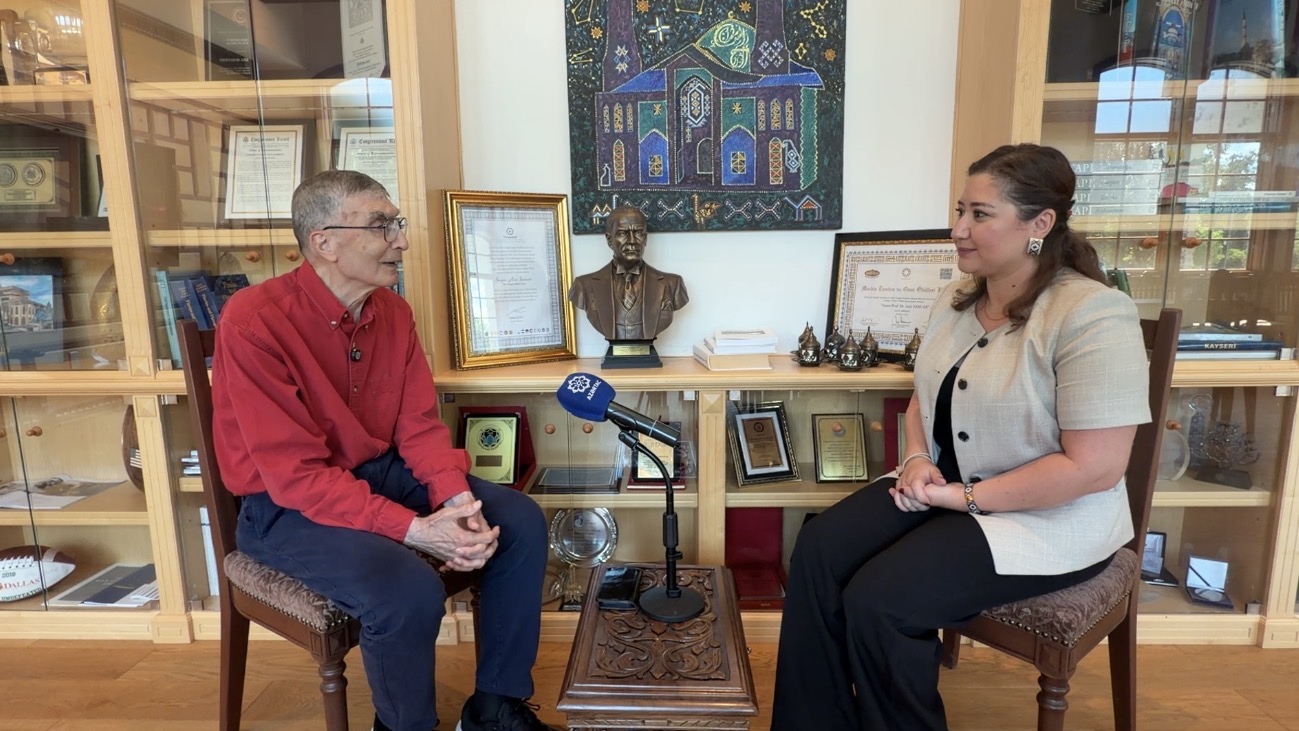
World-renowned scientist and Nobel laureate Aziz Sancar, who was awarded the "Shohrat" (Glory) Order by decree of the President of the Republic of Azerbaijan, Ilham Aliyev, spoke with AZERTAC. Below is the full interview.
– First of all, happy birthday! President Ilham Aliyev recently awarded you the "Shohrat" Order. What are your impressions of receiving this honor?
– I was not expecting it at all. It is wonderful news and, as I understand, one of Azerbaijan's highest state honors. I am deeply privileged. I have always held President Ilham Aliyev in high regard, so receiving an award conferred by him made me very happy.
– You have visited Azerbaijan several times. Overall, what does the country mean to you?
– Since my childhood, I have known Azerbaijan as a Turkic homeland under occupation. I actually listened to Azerbaijani music even more than Turkish music, so in that respect, I grew up immersed in Azerbaijani culture. Azerbaijan was always as important to me as Türkiye. At the same time, seeing it under Soviet rule caused me deep pain, which is why it has always held a special place in my heart. When Azerbaijan restored its independence, it was a source of immense joy for me.
– In several interviews, you have mentioned that you consider yourself Azerbaijani...
– As I mentioned, I grew up with Azerbaijani music – especially the songs of Zeynab Khanlarova. Our customs and traditions are practically identical. But beyond that, I always viewed Azerbaijan as a captive Turkic homeland. It was a deep longing in our hearts; we prayed for Azerbaijan to regain its independence, and finally, that dream came true.
– However, in the early 1990s, another tragedy struck with the occupation of Garabagh. What did the liberation of Garabagh mean to you?
– During my first visit to Azerbaijan, if I remember correctly, I was speaking with the Minister of Education. He mentioned that 20 percent of the country was under occupation and that they were actively working on how to liberate those lands.
That was when I learned about the occupation in greater detail, and I began following developments closely. When the Patriotic War began, I spent all my time tracking the frontline updates through the news and online.
It was a monumental victory. In 1922, Türkiye secured complete independence by expelling foreign forces from Anatolia. A century later, Azerbaijan eliminated the "cancerous growth" in the heart of its territory. It brought me immense pride and satisfaction.
– Deep cooperation exists between Türkiye and Azerbaijan across all sectors. How do you view the progress of bilateral ties in science and academia?
– Cooperation in these fields is very active. The Türkiye-Azerbaijan University has opened, and a large number of Azerbaijani students are currently studying in Türkiye. When I attended a conference in Garabagh, I noticed that half the audience consisted of students who had come over from Türkiye. In other words, academic mobility goes both ways. The two countries are becoming increasingly integrated.
– Turning to your field of scientific research, how significant a role could your work on DNA play in the future of cancer treatment?
– That is an important question. During one of my visits to Azerbaijan, I was asked the exact same thing. I explained that while this research will certainly be beneficial and aid in treatment, there is a much simpler preventative measure: if people stopped smoking, 70 percent of cancer cases would disappear.
That evening, my comment aired on the news. The next morning at breakfast, a young server at the hotel came up to me and said, "Professor, I saw you on TV yesterday, and I quit smoking."
Preventative measures are just as crucial as developing new medicines. Leading a healthy lifestyle—not smoking and avoiding excessive alcohol—is essential. Alcohol can trigger liver cancer, while smoking leads to lung and various other cancers.
That said, I hope our ongoing work on DNA repair, along with the brain cancer research we will be conducting over the next two to three years, brings great benefit to humanity.


